Why Strategy Board Games Are Having a Renaissance Right Now
By Dylan Wright • January 4, 2026
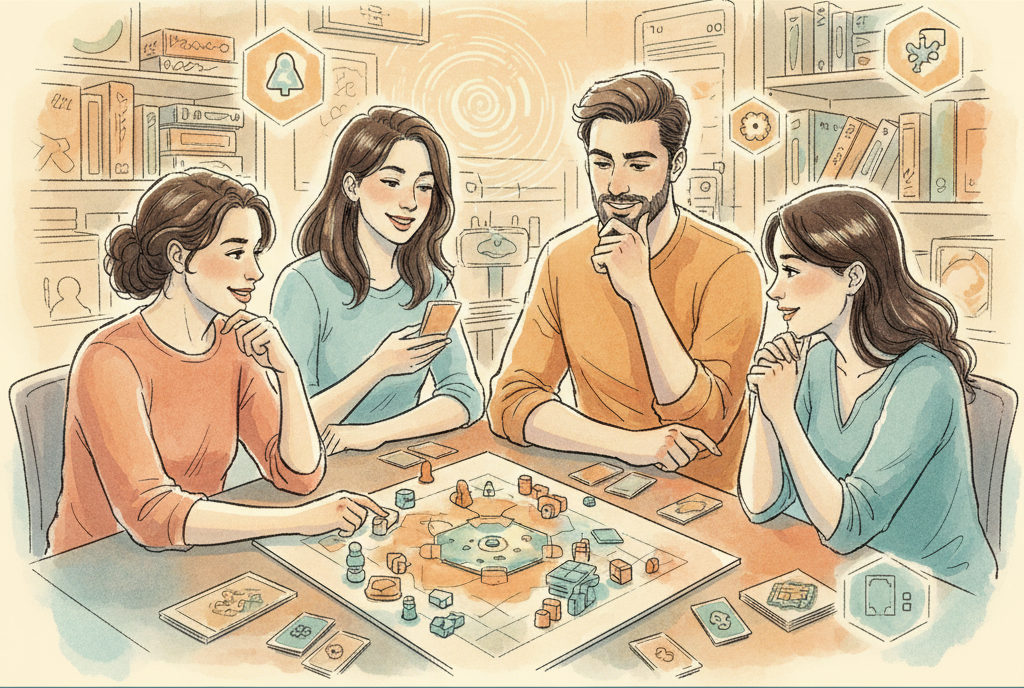
Ten years ago, talking about board games in a social setting would prompt one of two reactions: interest from the small subset of people who played them, or polite confusion from everyone else. Today, the conversation is different. Board game cafes are opening in cities around the world. Crowdfunding campaigns for new games routinely raise millions. Strategy game content on YouTube and Twitch draws audiences that would have been unthinkable a decade ago.
Something is happening. The question is: why now?
The Reaction to Screen Saturation
The most compelling explanation is the simplest one: we are saturated with passive screens. The average adult in a developed country now spends somewhere between six and nine hours per day looking at a screen — phones, computers, televisions, tablets. Much of that time is passive: scrolling, watching, consuming content that has been algorithmically delivered.
Strategy board games offer the opposite experience. They are active. They demand attention, decision-making, and engagement. When you sit down at a board game, you cannot scroll past it. You cannot watch someone else play and get the same experience. You have to be present.
For many people, especially those who spend their professional lives in front of computers, the deliberate attention required by a good board game is genuinely refreshing. It’s not escapism exactly — strategy games are cognitively demanding, often more so than the work you’re escaping from. But it’s a different kind of cognitive demand: purposeful, bounded, and clearly resolved within a session.
The Quality Revolution
The other major driver of the renaissance is a genuine and dramatic improvement in game design quality.
Board games have always existed, but for most of the 20th century the mainstream offerings were limited: Roll and move games like Monopoly. Party games. Trivia. Games designed primarily for families with no shared strategic vocabulary.
Starting in the 1990s with the introduction of games like Settlers of Catan to American and British markets, a new design philosophy began reaching mainstream audiences. These were games built around meaningful decisions, resource management, and competitive strategy — qualities that had previously been confined to war games and role-playing circles.
Since then, the design quality of strategy games has accelerated dramatically. Today’s strategy card games offer design sophistication that would have seemed remarkable fifteen years ago. The best modern designs are tight, efficient, beautiful artifacts — every mechanic serves a purpose, every card interaction is considered, and the games are balanced enough to support competitive play without breaking.
Social Media and the Discovery Effect
A third factor is discovery. Board games have always had passionate communities, but they struggled with visibility. You couldn’t stumble across a game in the same way you could stumble across a song or a film.
Social media changed this. Board game reviewers on YouTube with subscriber counts in the millions brought games to audiences that would never have found them through hobby stores. Content platforms allowed games to be demonstrated — watched rather than described — which is a far more effective way to understand what a game feels like.
This created a positive feedback loop: better visibility brought more players, more players created more demand for better games, better games attracted more reviewers, more reviewers created more visibility.
The Pandemic Accelerator
It would be incomplete to discuss the board game renaissance without acknowledging the role of the 2020-2021 pandemic period. Lockdowns created several months where millions of households needed ways to fill structured time together, and many of them discovered board games as an answer.
The lasting effect wasn’t just the players who discovered games during lockdowns — many of whom continued playing afterward. It was the cultural signal: board games appeared in mainstream media coverage, in social feeds, in gift guides. They went from a hobby interest to a broadly recognized leisure category.
The Online Bridge
The final piece of the puzzle is the move to online. Physical board games remain popular, but the shift to browser-based and app-based implementations has dramatically expanded access. You no longer need to own a physical copy of a game to play it. You no longer need to find friends who own the same game or live close enough to gather.
Online implementations of strategy card games have done for board gaming what streaming did for film: removed the access barriers. The player base has expanded accordingly, and with a larger player base comes more competitive depth, more written strategy, more community knowledge.
This is why platforms like Oxolot exist. The games in our library — Caravan, Gem Duel Blitz, Civ Duel, Scout — are expressions of the same design principles driving the broader renaissance: tight decision spaces, genuine strategic depth, replayability across hundreds of sessions.
The renaissance is real, and it’s being driven by players who want games that respect their intelligence and reward their attention. That’s not a niche preference. That’s a large and growing part of the gaming public.